How Much Does Water Softener Installation Cost in Houston?
| PHT Security Team
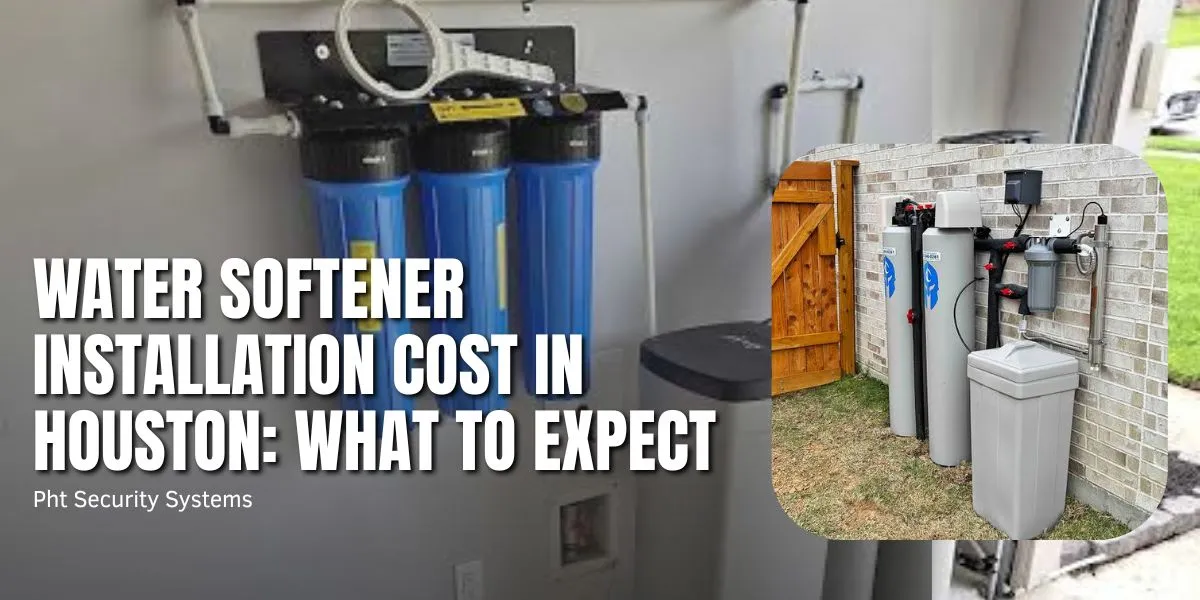
For a professional Water Softener Installation Cost in Houston, expect a total investment between $1,200 and $3,500, with most homeowners typically spending around $2,500 for a reliable, turnkey system. While it’s possible to find entry-level units online for under $1,000, that price rarely covers the specialized plumbing, local permits, or professional labor required to get the system integrated correctly into your home’s main water line.
If you’ve lived in Houston long enough, you know the drill: stubborn white crust scaling your faucets, soap that won’t lather, and dishes that come out of the dishwasher looking cloudy despite a full cycle. It’s the hard water reality we deal with locally. However, the final bill isn’t a one-size-fits-all number. The cost is usually driven by your home’s unique setup such as whether you have an existing water loop or need custom piping along with the capacity required to handle your household’s water usage. Let’s break down exactly what moves the needle on that cost so you can plan your budget with confidence.
Why Houston’s Water Is So Hard to Begin With
Houston pulls its water from a mix of surface sources, lakes and rivers, and groundwater drawn from limestone-heavy aquifers. That geology is the whole reason this is even a conversation. Limestone is basically compressed calcium, and as water travels through it, it picks up calcium and magnesium along the way.

Hardness across the Houston area runs roughly 7 to 12 grains per gallon, which puts most of the city somewhere between moderately hard and hard. It’s not uniform, though. Some of the outer suburbs that lean more on groundwater wells, places like Fulshear or Conroe, test even higher. Areas closer to the urban core that get more treated surface water, the Heights or Downtown for example, tend to run a bit softer, but “a bit softer” here still means hard water by any national standard. Anything above 7 GPG is generally considered worth treating, and once you’re past 10 GPG, most people in the water treatment world will tell you it’s not really optional if you want your plumbing to hold up long term.
What You’re Actually Paying For
Installation cost really comes down to two things: the softener itself, and the labor to put it in.
On the equipment side, salt-based ion exchange systems are the most common choice for Houston homes and tend to run $400 to $3,000. They’re also the most effective option for our hardness levels. Salt-free conditioners, which reduce scale rather than fully removing minerals, land in a similar $500 to $2,500 range. If you’ve got a bigger household or want continuous soft water with no downtime for regeneration, a dual-tank system will cost more, usually $2,500 to $5,000 or higher. And if you’re combining softening with deeper filtration through a reverse osmosis setup, plan on $2,000 to $5,000-plus.
Labor is where things get interesting, because it depends almost entirely on your home’s plumbing. Professional installation typically runs $150 to $1,000. If your house already has a pre-plumbed loop (that U-shaped section of copper or PEX pipe near the water heater built specifically for a softener), the job is quick and the labor bill stays low. You’ll see this a lot in newer construction around Katy, Sugar Land, and Pearland.
Older homes, especially anything built before the early 2000s, usually don’t have that loop. That means a plumber has to cut into the main line and build new connections from scratch, which can tack on several hundred dollars pretty fast.
System size matters too. Sizing comes down to how many people live in the house, how much water you use, and how hard your local water actually is. Most Houston households do fine with something in the 32,000 to 48,000 grain range. Bigger families or higher water usage might need 48,000 to 64,000 grains, and naturally, the bigger the tank and resin capacity, the more it costs upfront.
What Pushes the Price Up (or Keeps It Down)
It helps to understand why one neighbor pays $900 and another pays $4,500 for what sounds like the same job on paper.
Your home’s age and layout matter a lot. Older houses without an existing softener loop need more labor, and if your main line is buried behind a finished wall or tucked somewhere hard to reach, that adds time and cost.
Water hardness itself plays a role too. Harder water means you need a bigger system to keep up without the softener constantly cycling through regeneration.
Then there’s drain access. Salt-based systems need to backwash periodically, so they require a nearby drain line. If there isn’t one close to where the unit goes, running a new line is extra work and extra cost.
Brand and features add up as well. A basic softener with a mechanical valve costs less than one with digital controls and smart regeneration. The higher-end units often pay for themselves over time through lower salt and water use, but the sticker price is bigger going in.
As for permits, Houston generally doesn’t require one for a standard softener install. If the job touches electrical work or structural changes, though, your contractor might need to pull one, so budget an extra $50 to $200 just in case.
The Costs That Show Up After Installation
Installation is a one-time expense, but keeping the system running isn’t free. A 40-pound bag of sodium chloride runs $5 to $10, and most households burn through a few bags a month, which puts annual salt costs around $100 to $250. If you’re using potassium chloride instead, usually because you’re limiting sodium, expect closer to $25 to $30 a bag.
On top of that, occasional maintenance and eventual resin replacement (every 10 to 15 years or so) adds another $100 to $300 a year. Add it all up and most Houston homeowners spend $150 to $400 annually keeping a salt-based system running.
Is It Actually Worth the Money?
Here’s where the math tends to favor installing one. Hard water isn’t just an aesthetic annoyance. Over time, mineral scale builds up inside water heaters, washing machines, dishwashers, and the pipes themselves. A water heater fighting through that buildup loses efficiency, which quietly shows up as a higher energy bill every month. Appliances that should last 12 to 15 years can fail in half that time. According to the EPA, hardness minerals like calcium and magnesium aren’t a health hazard, but they’re still one of the most common reasons homeowners deal with scale, staining, and plumbing wear over time.
Weigh a $2,000 to $3,000 upfront cost against thousands of dollars in accelerated appliance replacement and plumbing repairs over ten years, and a softener usually pays for itself well before it needs to be replaced.
Should You DIY It or Call a Pro?
If you’re comfortable with plumbing and your home already has that pre-plumbed loop, installing a softener yourself is doable and can save you $400 to $600 in labor.
That said, most people in Houston hire a licensed plumber or a water treatment specialist for this, and there’s a good reason. A professional install cuts down the risk of leaks, makes sure the bypass valve is set up right, and confirms the system is actually sized for your water usage instead of a rough guess. If a DIY job goes sideways and you end up with water damage, any money you saved on labor disappears fast. Companies that specialize in this, like PHT Security’s water softener installation service, can test your water on-site and size the system correctly before anything gets installed.
How to Make Sure You’re Getting a Fair Price
A few things worth doing before you sign off on a quote.
Test your water first instead of going off citywide averages. A simple hardness test, or a professional water assessment, tells you exactly what you’re dealing with so you’re not paying for a bigger system than you actually need.
Get more than one quote. Pricing in Houston varies more than you’d expect between contractors, sometimes by over a thousand dollars for what’s essentially the same job, so comparing a few is worth the extra time.
Ask specifically whether you have a pre-plumbed loop. If you do, make sure the quote reflects that lower labor cost.
And look into financing if the upfront number feels steep. A lot of water treatment companies offer plans starting around $50 to $70 a month, which can make a higher-end system a lot more manageable.
Frequently Asked Questions
Does Houston require a permit for water softener installation?
Usually not. Standard installs don’t need one. If your project involves electrical or structural work, it’s worth checking with your local building department first.
What size water softener do I need for a Houston home?
Most households do fine with a 32,000 to 48,000 grain system, given Houston’s typical 7 to 12 GPG hardness. Larger families or higher water usage might need up to 64,000 grains.
How long does installation actually take?
If your home already has a plumbing loop set up, expect 2 to 4 hours. If new plumbing or a drain line needs to be added, it can stretch into a full day.
Salt-free or salt-based, which one’s better for Houston water?
For our hardness levels, salt-based ion exchange systems do a more thorough job of actually removing the minerals. Salt-free conditioners help with scale but don’t technically soften the water, so they’re a better fit if your water is milder or you’d rather avoid added sodium.
The Bottom Line
Plan on somewhere between $1,500 and $3,500 for a professionally installed whole-home water softener in most Houston homes. Your final number really comes down to your home’s existing plumbing, the size of the system you need, and how much labor the install requires. Given what hard water costs you over time in energy bills, cleaning products, and appliances that die early, it’s one of those upgrades that tends to pay for itself. If you want an exact number instead of a range, PHT Security offers free water testing, and you can reach out here to get a straight answer on what your specific home would need.

PHT Security Team
We believe everyone deserves to feel safe at home and at work. Our team shares practical security advice, helpful resources, and the latest insights on ADT systems, security cameras, smart home technology, and commercial security to help you make informed decisions. Whether you’re exploring your first security system or upgrading your current setup, we’re here to help you protect what matters most.
PHT Security Team
we believe everyone deserves to feel safe at home and at work. Our team shares practical security advice, helpful resources, and the latest insights on ADT systems, security cameras, smart home technology, and commercial security to help you make informed decisions. Whether you’re exploring your first security system or upgrading your current setup, we’re here to help you protect what matters most.