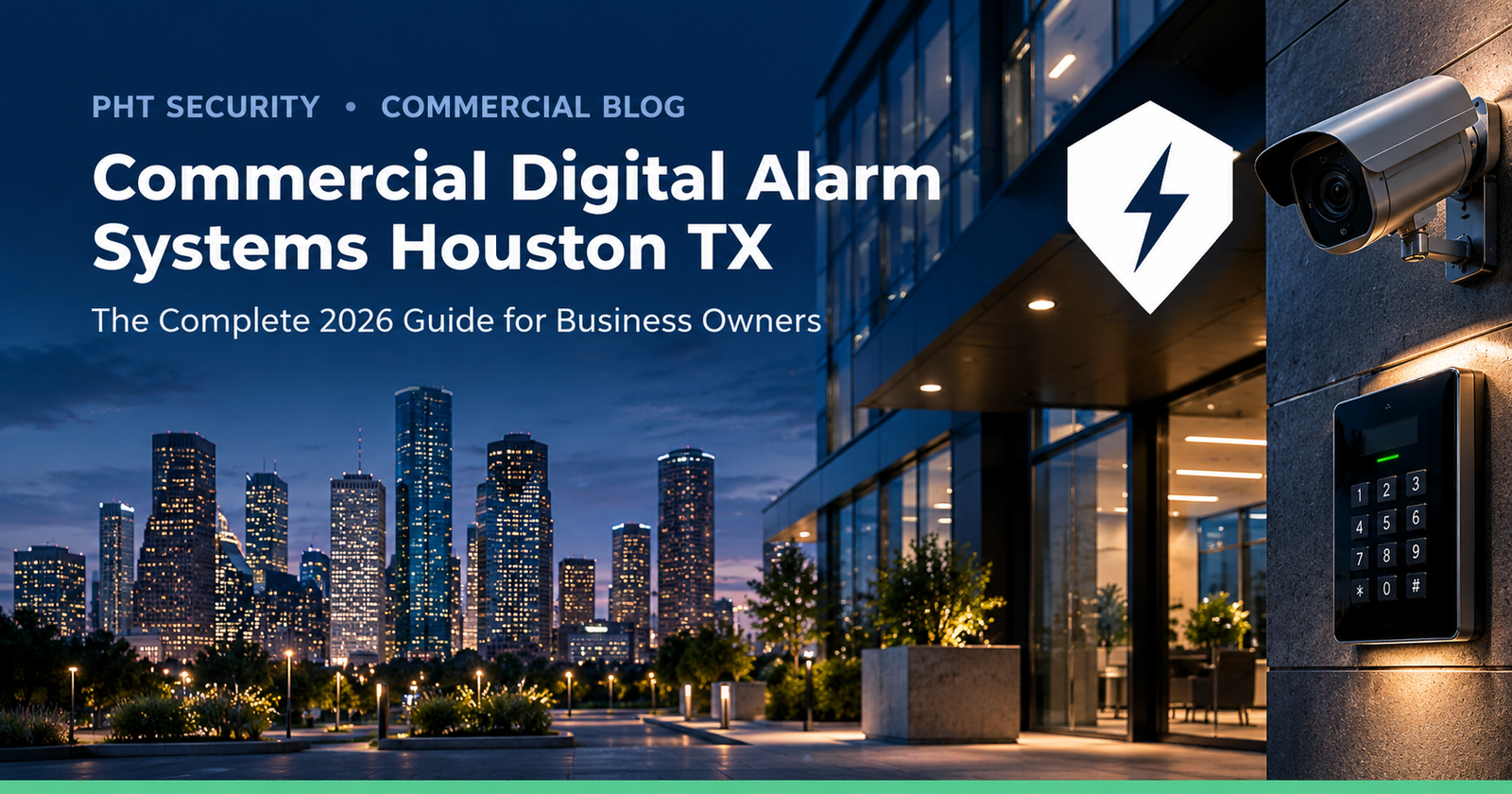
Commercial Digital Alarm Systems Houston TX: The Complete 2026 Guide for Business Owners
| PHT Security Team
A lot of what’s sold as “commercial” security in Houston is really a residential alarm system with a different label on the contract. If you’re researching commercial digital alarm systems Houston TX businesses can actually rely on, that distinction matters more than almost anything else in the buying decision because the gap between a real commercial system and a relabeled residential one shows up exactly when you need it most: during an actual break-in or an after-hours incident.
This guide walks through what separates genuine commercial digital alarm systems Houston TX providers install from a residential setup wearing a commercial price tag, what to look for before you sign a contract, and the Houston-specific compliance step most national guides skip entirely.
Why Commercial Digital Alarm Systems Houston TX Businesses Need Differ From Residential Setups
Homes and businesses have fundamentally different risk profiles. A home has a handful of entry points and one or two occupants who know the alarm code. A business a retail storefront, a warehouse, a medical office has multiple entry points, inventory worth protecting, staff turnover, after-hours cleaning crews, and liability exposure a homeowner never has to think about.
A residential alarm panel with a few door sensors and a keypad simply wasn’t built for that. Commercial digital alarm systems Houston TX businesses need are built around multi-zone coverage, cellular redundancy, and integration with video and access control not because commercial customers are being upsold, but because the actual risk profile is different.
The Hidden Problem With Relabeled Residential Systems
Some providers simply take their standard residential package, add a few extra sensors, and market it as a “commercial” solution. On paper, it looks like enough. In practice, it’s missing the infrastructure that makes a real commercial system worth the higher price: dedicated monitoring protocols, cellular backup that can’t be defeated by cutting a phone line, and room to scale as the business grows.
What “Commercial-Grade” Actually Means for Commercial Digital Alarm Systems Houston TX
A genuinely commercial-grade system is built around three things a residential system typically isn’t: redundant signal paths (cellular plus internet, not just one), multi user access control (so you know exactly who armed or disarmed the system and when), and a monitoring center that treats business accounts differently from residential ones faster escalation, different verification protocols, and direct lines to property managers or business owners rather than a single household contact.
4 Warning Signs Your System Isn’t a Real Commercial Digital Alarm System
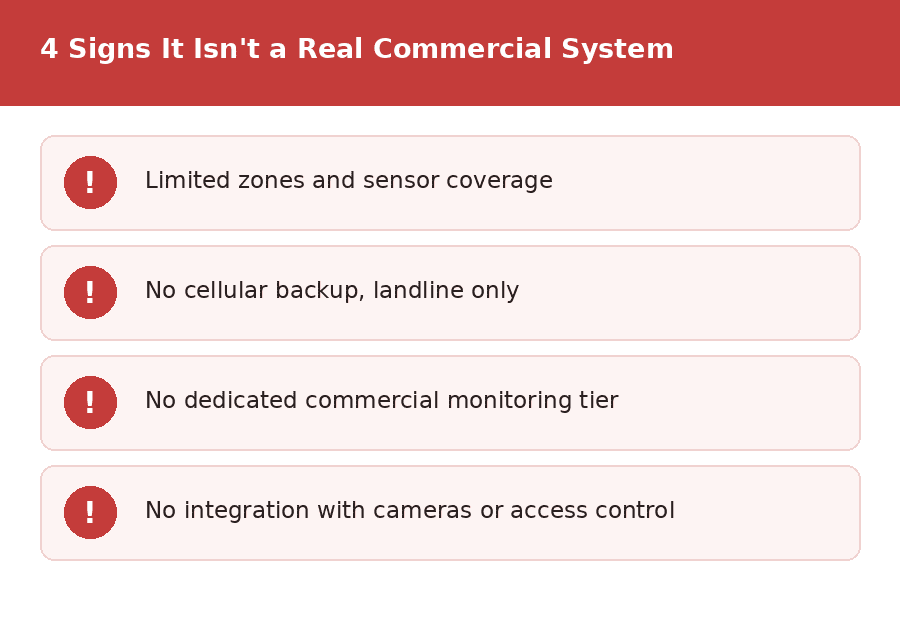
Across the providers we reviewed, the same four gaps keep showing up when a “commercial” package is really a residential system in disguise:
Limited Number of Zones or Sensors
Commercial spaces need coverage for multiple entry points, storage areas, loading docks, and after-hours zones that stay armed even during business hours in restricted areas. A system capped at the same zone count as a typical home package can’t actually cover a commercial footprint.
No Cellular Backup
A landline-only system is easy to defeat simply by cutting a phone line from outside the building a real and well-documented risk for standalone commercial buildings, especially ones with limited nighttime foot traffic nearby.
No Dedicated Commercial Monitoring Tier
Some monitoring centers route business and residential alarms through an identical protocol, with no difference in verification steps or escalation priority. A real commercial account should be flagged and handled differently from the moment an alarm triggers.
No Integration Path for Cameras or Access Control
A true commercial system should be able to tie into video verification and electronic door access, not just sound a siren and dial a number. Without that integration, you’re left with a keypad-and-siren setup that happens to have a commercial sticker price.
How Commercial Digital Alarm Systems Houston TX Benefit Local Businesses
Digital alarm systems the kind actually built for commercial use send signals over a dedicated digital or cellular path rather than a basic phone line, which means faster, more reliable signal delivery to the monitoring center. For a Houston business, that infrastructure translates into a few very practical advantages.
Scheduled Motion Zones Reduce False Alarms
Motion-activated zones can be scheduled around actual business hours, so a cleaning crew or early-arriving staff member doesn’t trigger a false alarm every single week. Fewer false alarms also means fewer unnecessary dispatch fees and less wear on the relationship with local law enforcement.
Multiple User Codes for Real Accountability
Instead of one shared code for the whole business, multiple authorized users can arm and disarm with their own individual codes. That means you know exactly who accessed the building and when useful for everything from after-hours deliveries to investigating an actual incident.
Alerts Route to More Than One Decision-Maker
A single phone number on file is a liability if that person is unreachable. With a proper commercial setup, alerts can route to multiple managers or owners simultaneously, so a response doesn’t depend on one person answering their phone at 2 a.m.
Compliance: Houston’s Commercial Alarm Permit Requirement
Businesses operating a monitored alarm system in Houston are required to register for a burglar alarm permit through the city’s alarm administration program. This isn’t optional paperwork operating an unregistered monitored system can result in fines if the alarm triggers a police or fire response.
Requirements and fees can change, so confirm current rules directly with the City of Houston’s official Burglar and Panic Alarms permitting page or with your alarm provider before installation. A provider experienced with commercial digital alarm systems Houston TX accounts should already have this permit process built into onboarding if a provider can’t walk you through it, that’s worth asking about directly.
Commercial vs. Residential Digital Alarm Systems: A Side-by-Side Comparison
| Feature | Typical Residential System | Real Commercial System |
|---|---|---|
| Zone capacity | Limited, built for a single household | Scalable for multiple entry points & storage areas |
| Backup connection | Often landline only or basic Wi-Fi | Cellular backup as standard |
| Monitoring protocol | Standard residential dispatch | Dedicated commercial escalation tier |
| User access | One or two shared codes | Multiple individual user codes |
| Integration | Rarely integrates with cameras/access control | Built to integrate with video & door access |
| Alert routing | Single contact | Multiple managers/owners simultaneously |
Industries in Houston That Benefit Most From Commercial Digital Alarm Systems
While every business benefits from better monitoring infrastructure, a few Houston industries see an outsized return on investing in a genuine commercial-grade setup rather than a relabeled residential one:
Retail Storefronts
Retail locations deal with multiple entry points, after-hours inventory risk, and regular staff turnover — all of which call for individual user codes rather than one shared code the whole team uses. Camera integration also matters more here than almost anywhere else, since retail theft disputes often come down to video evidence rather than just an alarm log.
Warehouses and Distribution Centers
Large footprints with multiple loading docks and storage zones need multi-zone coverage that a residential-grade panel simply can’t support. Cellular backup is especially important for warehouses in industrial areas with limited nearby foot traffic, where a cut phone line could otherwise go unnoticed for hours.
Medical and Dental Offices
Controlled substances and patient records make access logging and commercial-tier monitoring a genuine compliance consideration, not just a convenience. Knowing exactly which staff member accessed the building, and when, can matter well beyond security alone.
Restaurants
Late-night cash handling and early-morning deliveries make scheduled motion zones especially useful for cutting down false alarms from early kitchen staff or late cleaning crews, while still keeping the space fully armed overnight.
Professional Offices
After-hours cleaning crews, multiple staff members, and shared common areas all benefit from individual access codes and multi manager alert routing, so a single missed call doesn’t leave an incident unaddressed.
Choosing a Commercial Digital Alarm Systems Houston TX Provider: 5 Questions to Ask
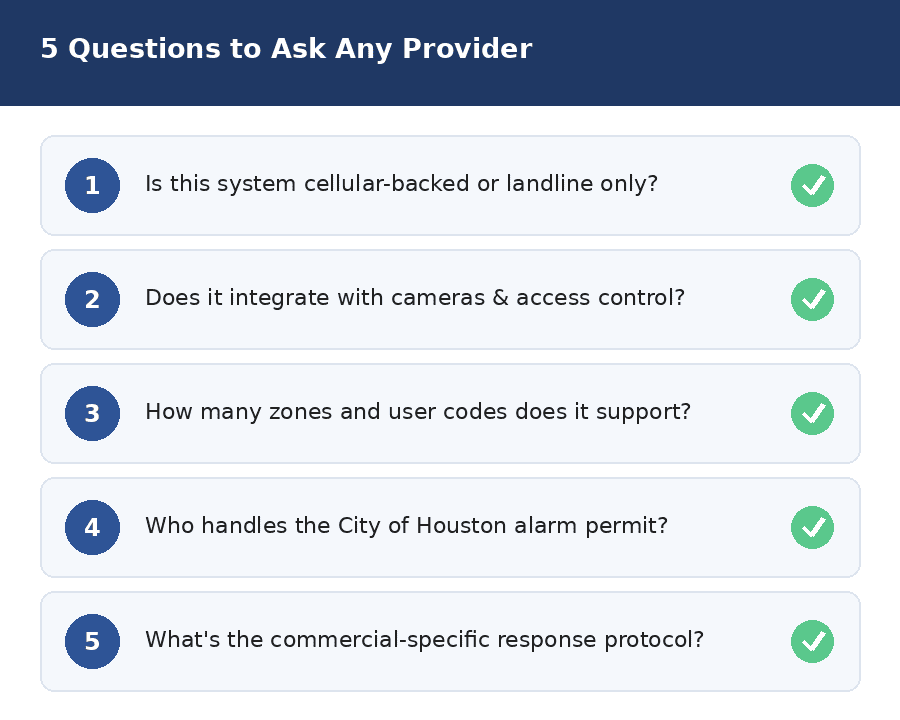
Once you’ve confirmed a provider isn’t just reselling a residential package, these five questions separate a serious commercial provider from one simply checking boxes:
1. Is This System Cellular-Backed, or Does It Rely on a Landline?
Cellular is far harder to disable from outside the building than a basic phone line, and it should be standard on any genuinely commercial setup.
2. Can This Integrate With Our Existing Cameras or Access Control?
This avoids running separate, disconnected systems that don’t talk to each other and it means an incident can be verified visually, not just triggered blindly.
3. How Many Zones and User Codes Does This Support?
This determines whether the system can actually cover a commercial footprint as the business grows, rather than being maxed out on day one.
4. Who Handles the City of Houston Alarm Permit?
This avoids compliance gaps after installation — a provider experienced with commercial accounts in Houston should handle this as a routine part of onboarding.
5. What’s the Response Protocol Specifically for Commercial Accounts?
This confirms the monitoring center treats business alarms as a priority with its own escalation path, not an afterthought handled identically to a residential account.
Budgeting for Commercial Digital Alarm Systems Houston TX: What Affects the Price
There’s no single flat rate across providers of commercial digital alarm systems Houston TX businesses can choose from, because the cost structure depends on several variables that have nothing to do with brand name:
- Zone count — more entry points, storage areas, and monitored rooms mean more hardware and configuration time.
- Camera and access control integration tying the alarm into existing video or door-access hardware adds setup complexity compared to a standalone panel.
- Monitoring tier — a dedicated commercial monitoring protocol with faster escalation typically costs more than a basic residential-style monitoring plan.
- Number of user codes — systems built for a dozen staff members with individual codes cost more to configure than a two-code residential setup.
- Installation complexity — a warehouse with multiple loading docks takes longer to wire and configure than a small single-entry office.
Rather than comparing a single advertised price across providers, ask each one for a full written quote that separates the base monitoring fee from equipment, installation, and any camera or access control integration costs. That’s the only way to compare two quotes for commercial digital alarm systems Houston TX providers offer on equal footing.
Where PHT Security Fits In
PHT Security installs and monitors ADT-backed commercial digital alarm systems Houston TX businesses depend on, built for multi-zone coverage and real integration with cameras and access control, not a residential package with a different label.
See our full commercial security offering on the Commercial Security Systems page.
Frequently Asked Questions About Commercial Digital Alarm Systems Houston TX
What’s the Difference Between Commercial Digital Alarm Systems Houston TX and Residential Alarms?
The core difference is infrastructure, not just branding. Real commercial digital alarm systems Houston TX businesses use include cellular backup as standard, multi-zone capacity for larger footprints, individual user codes, and a dedicated commercial monitoring protocol, none of which a typical residential package is built around.
Do I need a permit for a commercial alarm system in Houston?
Yes. Businesses operating a monitored alarm system in Houston are required to register for a burglar alarm permit through the city’s alarm administration program. Confirm current requirements directly with the city or your provider before installation.
How much do commercial digital alarm systems cost in Houston?
Cost depends heavily on zone count, camera integration, and monitoring tier, so there’s no single flat rate across providers. Ask for a full written quote that separates the base monitoring fee from equipment, installation, and any integration costs before comparing two providers.
Can a commercial alarm system integrate with my existing security cameras?
A genuinely commercial-grade system should be able to integrate with existing cameras and access control hardware rather than requiring you to replace everything. If a provider says this isn’t possible, that’s often a sign you’re being offered a residential-tier system.
What happens if my business doesn’t register its alarm system with the city?
Operating an unregistered monitored alarm system in Houston can result in fines, particularly if the alarm triggers an emergency response. Registration requirements and fees can change, so verify current rules directly with the city before your system goes live.
Bottom Line: Protecting Your Business With the Right Commercial Digital Alarm System in Houston TX
Not every system marketed as “commercial” actually performs like one. Before signing with any provider of commercial digital alarm systems Houston TX businesses are offered, confirm the connection type, zone capacity, integration options, permit handling, and commercial-specific response protocol. Those five things, not the word “commercial” printed on the brochure, are what actually protect a business when it matters.

PHT Security Team
We believe everyone deserves to feel safe at home and at work. Our team shares practical security advice, helpful resources, and the latest insights on ADT systems, security cameras, smart home technology, and commercial security to help you make informed decisions. Whether you’re exploring your first security system or upgrading your current setup, we’re here to help you protect what matters most.
PHT Security Team
we believe everyone deserves to feel safe at home and at work. Our team shares practical security advice, helpful resources, and the latest insights on ADT systems, security cameras, smart home technology, and commercial security to help you make informed decisions. Whether you’re exploring your first security system or upgrading your current setup, we’re here to help you protect what matters most.