Commercial Fire Alarm Monitoring in Houston: What Business Owners Actually Need to Know
| PHT Security Team
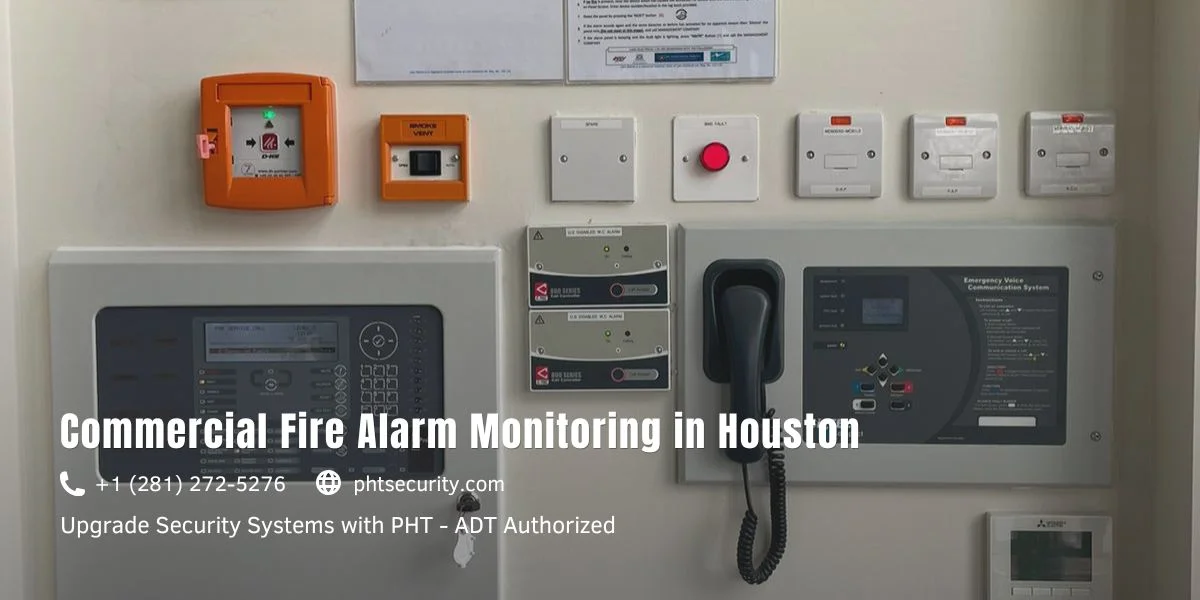
Here’s something that catches a surprising number of Houston business owners off guard. A fire alarm panel and monitored fire alarm are not the same thing. A panel with disconnected monitoring will still make noise if smoke triggers a detector. What it won’t do is tell the fire department anything, especially at 3 a.m. on a Sunday when nobody’s inside to hear it.
That gap, panel present, monitoring missing, is one of the most common violations Houston Fire Marshal inspectors run into, and it’s an expensive one to get caught with. If you own or manage commercial space anywhere from the Energy Corridor to the Ship Channel, the Medical Center to Katy, here’s exactly what the code requires, what changed recently, and what it actually costs to get right. For a wider look at how fire alarm monitoring works across the Houston area, that’s a useful starting point before diving into the commercial-specific requirements below.
What Commercial Fire Alarm Monitoring Actually Does
A local bell system does exactly one thing: it makes noise inside the building. A monitored system does something a lot more useful. It puts your building on the fire department’s radar within seconds of a real event, whether anyone’s on-site to notice or not. It’s a similar principle to the one that separates self-monitoring from professional alarm monitoring on the residential side: someone or something has to actually be watching for the alert to matter.
Here’s roughly how that plays out when a detector actually triggers in a properly monitored building.
The fire alarm control panel registers the signal and identifies which device tripped. That signal travels over a primary communication path, with a backup path running at the same time, to a UL-listed central monitoring station. Trained operators receive the alert within seconds, reach out to your designated contact, and simultaneously notify the fire department. NFPA 72 requires prompt transmission to emergency services once an alarm is confirmed, though the exact timing requirements can vary by edition and by your local fire marshal’s interpretation, so it’s worth confirming the specifics with your provider rather than relying on a single quoted number.
Every one of these events gets logged with a timestamp. Those logs become your compliance record during annual fire marshal inspections. Without them, you don’t have documentation, and without documentation, you’re looking at a citation even if the hardware itself is fine.
Who Actually Needs Monitoring Under Houston Fire Code
Houston enforces fire and life safety requirements based on the International Fire Code with local amendments, layered alongside NFPA 72 and NFPA 101. The Houston Fire Marshal’s Office handles enforcement, and it applies to a wider range of buildings than most owners assume.
Monitoring generally isn’t optional if your building falls into any of these categories:
- Any building with a fire sprinkler system, since waterflow and valve tamper monitoring is required alongside it
- Assembly occupancies over roughly 300 people, plus educational and institutional buildings
- Business or mercantile occupancies over about 2,000 square feet
- Daycares, medical clinics, and restaurants with 50 or more occupants
- Warehouses storing hazardous materials
- Buildings over three stories, and high-rises above 75 feet carry additional requirements, including voice evacuation systems tied directly into the fire panel
If your property sits in unincorporated Harris County rather than inside Houston city limits, a slightly different rulebook applies, enforced by the Harris County Fire Marshal’s Office. That distinction is worth nailing down before you install or upgrade anything, since the two offices don’t always require the same thing. It’s also worth knowing that commercial requirements aren’t just a stricter version of residential rules, they’re a genuinely different set of obligations, which residential vs. commercial fire alarm monitoring breaks down in more detail.
What Changed With the Recent Fire Code Update
Houston’s move to a newer International Fire Code, with local amendments layered on top, expanded mandatory monitoring into occupancy types that used to qualify for exemptions. If you want the fundamentals first, how fire alarm monitoring actually works is a good primer before getting into what’s new. A few changes are worth flagging specifically.
Voice evacuation is no longer optional in many assembly spaces. Event venues, large restaurant dining rooms, and multipurpose halls that previously had flexibility here often don’t anymore.
Mass notification integration is increasingly required. Many commercial panels now need to connect with a mass notification platform so occupants can be reached directly during an emergency, not just alerted by a siren.
Documentation gets checked more closely. Inspectors are asking for battery logs, test records, and component certifications on the spot. If your system passed inspection a couple of years ago and hasn’t been reviewed since, there’s a real chance it wouldn’t pass today, not because the equipment failed, but because the paperwork didn’t keep up.
What Skipping Monitoring Actually Costs You
Fines for non-compliant commercial fire systems in Houston can run into the hundreds of dollars per day the violation continues, with escalating penalties for repeat or serious violations. Exact amounts depend on the specific violation and how your inspector classifies it, so it’s worth confirming current fine schedules directly with the Fire Marshal’s Office rather than assuming a fixed number applies to your situation.
The fines are rarely the expensive part, though. A local-only bell system depends entirely on someone nearby noticing and calling 911. In an unoccupied building overnight or on a weekend, that delay can turn a contained incident into a much larger loss, both in property damage and in the time a business spends closed while repairs and inspections get sorted out.
The insurance angle gets missed a lot too. Most commercial property insurers require proof of UL-listed central station monitoring to maintain full coverage, and many offer premium reductions, commonly cited in the 10 to 20 percent range, for verified central station certificates. Monthly commercial monitoring typically runs somewhere between $30 and $60 depending on system size and how many communication paths you’re running. Once you factor in the insurance side, that cost looks a lot more reasonable.
Wireless Monitoring: A Practical Retrofit for Older Buildings
Running new conduit through a decades-old building in the Heights, a tilt-wall warehouse in Stafford, or a historic structure in Midtown is disruptive and expensive. It’s a common issue in older commercial corridors across the metro, including properties we work on through our Missouri City service area. For a lot of these properties, wireless commercial fire alarm monitoring has become the more practical, code-compliant path forward.
Modern wireless systems typically use encrypted cellular as the primary path, with a mesh radio backup that keeps working through extended power outages, the kind Houston has seen more than once in recent years. They can meet NFPA 72 requirements without cutting into drywall or ceilings, and installation is generally faster than a wired retrofit.
That backup path isn’t a nice-to-have. NFPA 72 requires both a primary and secondary communication pathway for monitored commercial systems, and a fair number of older Houston buildings are still running on a single phone line as their only path, which likely puts them out of compliance already.
What to Look for in a Monitoring Provider
Not every provider meets the same bar, and Houston’s fire code is specific about what qualifies.
Your provider’s central station needs UL listing or FM approval, redundant communication infrastructure, and the ability to produce documented response-time reports for your annual fire marshal review. That paperwork is what protects you when an inspector walks in asking questions.
One detail catches a lot of owners off guard: the technician installing or servicing your system needs a valid Alarm Certificate of Registration from the Texas State Fire Marshal’s Office. If an inspection turns up an unlicensed technician, the citation goes to the building owner, not the contractor. Most owners don’t find this out until it happens to them.
If you’re comparing monitoring providers more broadly, how to choose the right alarm monitoring company walks through what actually separates a solid provider from a mediocre one, most of it comes down to the details covered above: certifications, redundancy, and documentation.
PHT Security Systems works as an ADT Authorized Dealer across the Houston metro, connecting commercial systems to ADT’s monitoring services, including Five-Diamond certified central stations built around fast signal-to-dispatch performance. For properties that need fire monitoring alongside broader coverage, access control, surveillance, backup power, commercial security systems can bring all of that under one provider relationship instead of several.
Frequently Asked Questions
How much does commercial fire alarm monitoring cost in Houston?
Most small to mid-size businesses pay somewhere between $30 and $60 a month for central station monitoring with backup communication paths. Factor in potential insurance premium reductions, and the net cost often ends up lower than it looks upfront.
My building already has a fire alarm panel. Do I still need monitoring?
In most cases, yes, if your occupancy type or building size falls under Houston’s monitoring requirements. A panel alone doesn’t satisfy the off-premises notification requirement under NFPA 72. The signal needs to reach a UL-listed central station to count as compliant.
How fast does the fire department actually get notified?
With a well-run monitoring setup, signal-to-dispatch times commonly land somewhere between 30 and 60 seconds from detection. Ask any provider you’re considering for their documented average rather than taking a general industry number at face value.
Can a wireless system meet Houston’s commercial code requirements?
Yes, as long as the components carry proper listing, the system runs both a primary and backup communication path, and the design goes through fire marshal plan review before installation.
What happens if I get a red tag from the fire marshal?
A red tag pulls your system out of service immediately and requires corrective action before the building can legally keep operating in many occupancy types. A yellow tag comes with a correction deadline instead. Both go on record and can affect your permit status.
Does monitoring actually lower my business insurance premium?
Usually, yes. UL-listed central station monitoring is widely recognized in commercial insurance rating, and many carriers apply meaningful discounts, often cited in the 10 to 20 percent range, for properties with a valid central station certificate.
The Bottom Line
Houston’s fire code is actively enforced, and the recent updates have real teeth for occupancy types that used to have more flexibility. A fire alarm panel without monitoring is a bit like a security camera that records footage but never sends an alert. Nobody notices until well after the fact.
If you’re not sure whether your current setup actually meets today’s requirements, a professional compliance check is a lot cheaper than finding out the hard way during an inspection. Schedule a free commercial fire safety evaluation with PHT Security Systems and get a clear answer on where your property actually stands.

PHT Security Team
We believe everyone deserves to feel safe at home and at work. Our team shares practical security advice, helpful resources, and the latest insights on ADT systems, security cameras, smart home technology, and commercial security to help you make informed decisions. Whether you’re exploring your first security system or upgrading your current setup, we’re here to help you protect what matters most.
PHT Security Team
we believe everyone deserves to feel safe at home and at work. Our team shares practical security advice, helpful resources, and the latest insights on ADT systems, security cameras, smart home technology, and commercial security to help you make informed decisions. Whether you’re exploring your first security system or upgrading your current setup, we’re here to help you protect what matters most.