If you search “fire alarm monitoring Houston” right now, you’ll find pages that either list services without explaining them, or explain the national standards without mentioning anything about how things actually work in this city.
This guide does both. Whether you own a home in Meyerland, run a restaurant on Westheimer, or manage a warehouse near the Ship Channel, here’s everything you need to know before choosing a fire alarm monitoring provider in Houston.
Why Fire Alarm Monitoring Matters More in Houston Than You Might Think
Let’s start with the local reality.
Houston’s older neighborhoods the Heights, Montrose, Bellaire, and large parts of Meyerland have housing stock built anywhere from the 1920s to the 1970s. Electrical systems in those homes were designed for a fraction of today’s electrical load. In summer, attic temperatures routinely climb above 130°F, accelerating the degradation of aging wiring insulation. That combination of old infrastructure and extreme heat creates a fire risk profile that newer suburban construction simply doesn’t have.
On the commercial side, Houston is one of the most industrially diverse cities in the country. Petrochemical facilities along the Ship Channel, restaurant corridors on Westheimer, healthcare campuses in the Medical Center, office parks in the Energy Corridor each of these environments carries distinct fire risks and faces distinct code obligations.
And then there’s the weather. Hurricane Beryl knocked out power to roughly 700,000 CenterPoint Energy customers in July 2024. Homes and businesses relying on systems that used only landline communication or had no battery backup were essentially unmonitored for days. That’s not a hypothetical risk — it happened.
A professionally monitored fire alarm system addresses all of these vulnerabilities. But not every system, and not every provider, is built the same way.
What “Monitored” Actually Means And What Happens When Your Alarm Goes Off
Most people have a rough idea: an alarm goes off, someone gets notified. The details matter more than most realize.
When your fire alarm panel detects smoke, heat, or activation of a manual pull station, it sends an electronic signal over a dedicated communication path to a central monitoring station. The best systems use dual-path communication cellular plus IP, or cellular plus radio so if one path fails, the signal still gets through.
At the central station, a trained operator receives the signal and initiates the response sequence. Under NFPA 72 Chapter 26, the station must notify the appropriate fire authority within 90 seconds of receiving a confirmed alarm signal. For properties inside Houston city limits, that authority is the Houston Fire Department’s Fire Prevention Bureau. For properties in unincorporated Harris County, it falls under the Harris County Fire Marshal.
The practical difference between a monitored and unmonitored system comes down to one scenario: what happens when nobody is there to call 911.
A smoke alarm on your ceiling beeps. If you’re home, you hear it and act. If you’re at work, or asleep on the other side of the house, or simply not there the beeping does nothing. A monitored system doesn’t need you to be present. It acts on your behalf, automatically, in under 90 seconds.
If you’re curious about the mechanics behind this rapid response, our guide on how alarm monitoring protects your property explains exactly what happens the second a sensor triggers.
HFD’s average response time across most of Harris and Fort Bend counties runs between 8 and 11 minutes. In a structure fire, that window is the difference between a contained incident and total loss. Flashover — the point at which a room fire becomes fully developed and unsurvivable can happen in as little as five minutes under the right conditions.
The Three Types of Monitoring Setups Houston Residents and Businesses Should Know
Not all monitoring is equal. NFPA 72 recognizes three primary types of supervised monitoring stations, and understanding the difference helps you ask the right questions.

UL-Listed Central Station Service is the gold standard. These facilities have been independently certified by Underwriters Laboratories under UL 827, meaning they’ve met specific standards for staffing, redundancy, backup power, response protocols, and documentation. For commercial properties in Houston that require off-premises notification under NFPA 72, a UL-listed central station is the required standard. When you see a provider advertise “UL-listed monitoring,” this is what they’re referring to.
Remote Station Service connects your system to a monitoring location that doesn’t carry full UL central station certification. These stations may be AHJ-approved for some applications but don’t meet the more stringent requirements of true central station service. The line between the two gets blurry in sales conversations, so it’s worth asking directly: is your central station UL-listed under UL 827?
Proprietary Supervising Station monitoring means the property owner operates their own monitoring center common in large hospital campuses or corporate facilities with dedicated security staff. Most residential and small commercial customers won’t deal with this setup.
For PHT Security’s customers, monitoring runs through ADT’s Five Diamond certified central station Five Diamond is a CSAA (Central Station Alarm Association) designation that indicates the station has met the highest tier of operator training and response standards.
When Is Fire Alarm Monitoring Required in Houston? (The Honest Answer)
This is the question most providers dodge, either because the answer is complicated or because they’d rather just sell you something.
Here’s the straightforward version.
The City of Houston Fire Code, Section 901, adopts NFPA 72 as the controlling standard for fire alarm systems within city limits. Under that framework, monitored fire alarm systems are required for:
Commercial occupancies with 50 or more occupants. This covers a lot of ground restaurants, retail stores, fitness centers, event spaces, and many office buildings.
Any building over three stories. Height creates evacuation challenges that require earlier notification.
High-hazard occupancies, including warehouses, manufacturing facilities, and properties handling flammable materials. Much of the industrial area east of downtown and along the Ship Channel falls into this category.
Properties with fire sprinkler systems. Sprinkler supervision monitoring of tamper switches and water flow is mandatory whenever sprinklers are present. If your sprinklers are not connected to a monitored system, you’re almost certainly non-compliant.
Daycares, healthcare facilities, and assisted living centers, regardless of size.
For properties in unincorporated Harris County or Fort Bend County, the requirements follow the same NFPA 72 baseline but are enforced by the respective county fire marshals rather than HFD.
Residential properties in Houston are not generally required by code to have monitored fire alarms, but insurance carriers increasingly require it for certain property types and coverage levels. And practically speaking, for any home where people sleep especially with children it’s the most meaningful life-safety upgrade available.
If you’re not sure whether your property requires monitoring, the fastest way to find out is to contact a licensed fire alarm company that knows Houston’s AHJ requirements. A phone call takes ten minutes and saves a lot of guesswork.
Houston’s False Alarm Problem and Why It Matters for Your Monitoring Setup
Here’s something almost no fire alarm provider in Houston talks about publicly: the City of Houston has a false alarm ordinance, and it includes fines for excessive false dispatches.
After a defined number of false alarm responses within a permit period, HFD can assess fees. For businesses, repeated false alarms can also trigger inspection scrutiny and create insurance complications.
This matters for your monitoring setup in two practical ways.
First, your monitoring provider should have an alarm verification process. Before dispatching HFD on an ambiguous signal, operators should attempt to contact the account holder to confirm whether the alarm is real. Many modern systems support “enhanced call verification” that gives you a short window to cancel a false dispatch before emergency services are rolled.
Second, your detectors should be appropriate for their environment. Ionization detectors in a kitchen, or standard smoke detectors in a garage, generate nuisance alarms constantly. Choosing the right detector type for each zone of your property photoelectric in sleeping areas, heat detectors in garages and attics, duct detectors in HVAC systems dramatically reduces false alarms without reducing real protection.
Residential Fire Alarm Monitoring in Houston: What Makes a Good System
For homeowners, the conversation usually starts with the question of whether a smart home smoke detector is enough. For most houses in Houston, the honest answer is: it depends on your situation, but for anything beyond a basic apartment or newer construction, a monitored system is meaningfully better.
A well-designed residential monitored fire alarm system in Houston includes:
Photoelectric smoke detectors as the primary detection device. Photoelectric technology responds faster than ionization to slow, smoldering fires the kind most likely to develop at night or in a room nobody is currently in. This isn’t a minor distinction; smoldering fires are responsible for most residential fire fatalities because they produce large amounts of toxic smoke before visible flame appears.
Heat detectors in garages, attics, and kitchens where cooking fumes or temperature extremes would trigger constant false alarms from smoke detectors.
Low-frequency sounders (520 Hz) that are significantly more effective at waking deep sleepers, particularly children, than the standard 3,000 Hz horn. NFPA 72 now includes provisions recognizing this, and it’s worth specifically asking for when your system is designed.
Cellular communication as the primary transmission path. Landlines fail during power outages and can be cut deliberately or accidentally. 5G cellular ensures the signal gets through even when your home has no power.
72-hour battery backup at minimum, so the system survives extended CenterPoint outages like those seen during Hurricane Beryl.
Smart integration the ability to manage your system from a phone app, receive alerts, and silence nuisance alarms without disabling the system has moved from a premium feature to a practical necessity in most modern installs.
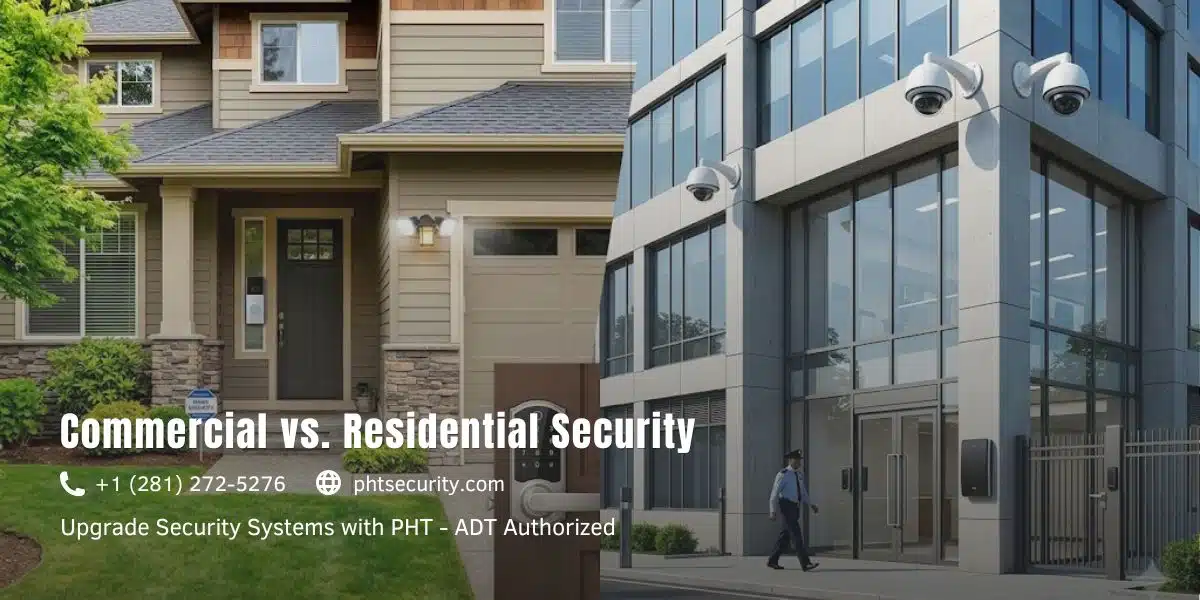
While these systems share core technology, there are distinct differences in hardware and code requirements learn more about the differences between residential and commercial fire alarm monitoring before you make a decision.
Commercial Fire Alarm Monitoring in Houston: What Businesses Need Beyond the Basics
Commercial monitoring is a different conversation from residential, and not just because the buildings are larger.
Every commercial fire alarm installation in Houston requires a licensed fire alarm technician under the Texas State Fire Marshal’s Office (SFMO) licensing rules. Installation cannot be done by the property owner or by unlicensed contractors. The work must comply with NFPA 72 and be documented for annual inspection and certification.
For Houston businesses, a complete commercial monitoring program covers several components that residential systems don’t require:
Sprinkler flow monitoring notifies the central station when a sprinkler head activates. This triggers emergency dispatch and helps minimize water damage through faster response.
Tamper switch supervision sends an alert if someone shuts off the water supply to your sprinkler system — whether accidentally or intentionally. Under NFPA 72, this supervision is mandatory when sprinklers are present.
Duct smoke detectors mounted in HVAC systems detect smoke being distributed through the building before it reaches other sensors, and can trigger automatic HVAC shutdown to prevent smoke spread.
Elevator recall integration ensures elevators return to ground floor and lock out during an alarm — a life-safety requirement in most multi-story Houston commercial buildings.
Annual NFPA 72 certification by a licensed technician. This documentation is required for HFD permit renewal and is regularly requested by commercial insurance carriers during policy renewals. Operating a commercial building without current certification creates real liability exposure.
Commercial monitoring costs in Texas generally run between $35 and $100 per month depending on system size and communication method. That number is worth putting in context: a single false alarm callout fee from HFD costs more than a full year of monitoring for many small businesses.
For business owners seeking a deeper look into the specific regulatory landscape, we’ve broken everything down in our complete commercial fire alarm monitoring guide.
Wireless Fire Alarm Systems: Why They’ve Taken Over Houston Retrofits
Five years ago, wireless fire alarm systems were a compromise useful when wiring wasn’t feasible, but considered less reliable than hardwired systems. That perception has shifted significantly.
Modern wireless systems use 5G cellular plus mesh radio as redundant communication paths, meaning they’re often more reliable than a single hardwired connection to a POTS line. Sensors operate on 10-year lithium batteries. Installation requires no wall penetration, no conduit runs, and no drywall repair.
In Houston, this matters for a specific reason: the city’s most desirable neighborhoods are also its oldest. Running new fire-rated cable through a 1920s Heights craftsman bungalow or a 1950s Meyerland ranch involves opening finished walls, dealing with potential asbestos in older insulation, and significant restoration costs afterward. For most of these properties, wireless isn’t the fallback option it’s the right option.
The majority of retrofit fire alarm installations across Houston in 2026 are wireless or hybrid (new wireless sensors connected to an existing hardwired panel). The technology has matured to a point where the reliability concern is largely behind us.
Modern advancements have made these systems incredibly reliable for older Houston architecture; you can explore our specific wireless fire alarm monitoring solutions here.
What to Ask Before Choosing a Fire Alarm Monitoring Company in Houston
The Houston market has no shortage of providers. Here’s how to cut through the noise.
Is the central station actually UL-listed?
Not all monitoring centers are. UL listing under UL 827 means the facility has been independently inspected and certified. For commercial properties, a UL-listed station is required under NFPA 72. Ask for the station’s UL certificate number if you want to verify.
Are your technicians licensed by the Texas SFMO?
Commercial fire alarm work in Texas requires a specific state license. Ask to see it. This is especially important for commercial clients, but it’s a useful indicator of professionalism for residential work too.
What communication paths does the system use?
Single-path systems phone line only, or IP only are vulnerable to the exact conditions Houston weather creates. Dual-path (cellular plus IP or cellular plus radio) is the standard you should expect.
How do you handle false alarm verification?
Ask whether the monitoring center uses enhanced call verification before dispatching HFD. The answer tells you a lot about how the provider thinks about alarm management versus just alarm response.
Are your technicians local?
A company dispatching technicians from Dallas or San Antonio is not going to be at your door quickly when something needs attention after a storm. Same-day local service response matters especially in the hours after a hurricane when the whole city needs attention simultaneously.
What does the monitoring contract actually cover?
Some agreements look competitive on the surface but charge separately for trouble signal responses, annual test supervision, and false alarm verification calls. Read the fine print before signing.
PHT Security Systems: Houston-Based, ADT-Backed, Locally Operated
PHT Security Systems operates as one of the longest-running authorized ADT monitoring services in Houston, with over a decade of local installations across residential and commercial properties.
Monitoring runs through ADT’s Five Diamond certified central station, which consistently meets the 30-to-60-second dispatch window and provides complete documentation for HFD permit compliance and insurance purposes. For homeowners, PHT installs systems with cellular-primary communication, 72-hour battery backup, and proper detector placement photoelectric in living areas, heat detectors in garages and attics, and low-frequency sounders for better sleep-wake performance.
For commercial clients, PHT handles the full scope: system design, licensed installation, sprinkler supervision, annual NFPA 72 certification, and ongoing monitoring. The company has completed installations at restaurants on Westheimer, medical offices in the Medical Center, industrial properties near the Ship Channel, and office buildings across the Energy Corridor.
Because PHT also installs whole-home generators and solar systems, fire monitoring can be paired with backup power infrastructure something standalone fire companies can’t offer. During multi-day outages like those following Hurricane Beryl, that integration is the difference between a system that’s fully operational and one that’s running on dwindling battery reserve.
PHT is at 2626 South Loop West, Suite 423, Houston, TX 77054. Local technicians, local knowledge, same-day response.
Frequently Asked Questions
How fast does HFD get notified when my alarm goes off?
With a UL-listed central station, the dispatch sequence from signal receipt to HFD notification takes 30 to 60 seconds. NFPA 72 Chapter 26 sets a 90-second maximum. HFD’s average arrival time in most of Harris and Fort Bend counties is 8 to 11 minutes from the time they’re dispatched.
Will my monitored fire alarm work during a CenterPoint power outage?
Yes, if the system is properly designed. Cellular communication operates independently of your home’s power. Battery backup of 72 hours handles most outage scenarios. For extended events, generator tie-in keeps the system running indefinitely.
Do I need a permit from the City of Houston for a monitored fire alarm?
Yes. Houston Fire Code requires an alarm permit for monitored systems. Your installation provider should handle the permit application as part of the installation process. Operating without a permit can create problems during HFD inspections and may affect your insurance coverage.
What’s the difference between UL-listed and non-UL-listed monitoring?
UL listing under UL 827 means the monitoring facility has been independently certified for response time, redundancy, staffing protocols, and operations. For commercial properties, NFPA 72 requires a UL-listed station. For residential customers, it’s the standard you should expect from a credible provider.
Can fire monitoring be added to an existing ADT security system?
In most cases, yes. Fire monitoring circuits can typically be added to an existing compatible panel at little or no additional equipment cost. PHT can assess your existing system during a free on-site consultation.
How much does fire alarm monitoring cost in Houston?
Residential monitoring starts around $36 to $50 per month, depending on system size and features. Commercial monitoring typically runs $50 to $100 per month for standard systems, though larger or more complex installations may vary. These figures don’t include installation costs, which depend on the size and type of system.
Get a Free Fire Safety Evaluation
If you want to know whether your home or business needs a monitored fire alarm, what it would cost, or whether your current system meets Houston Fire Code requirements, PHT Security Systems offers free on-site fire safety audits with no pressure and no obligation.
Call (281) 272-5276 or schedule online Appointment
Houston technicians. Houston code knowledge. Same-day response.